P/R:Thirty olive trees cut nearby the Palestinian village of At-Tuwani, South Hebron Hills

agosto 19, 2012 at 3:30 pm

The olive grove belongs to a Palestinian family and it is located in front of Havat Ma’on illegal outpost

(Italian follows)

August 16th, 2012

At-Tuwani – South Hebron Hills

In the afternoon of August 16th some Palestinians discovered that an olive grove situated in Humra valley had been recently destroyed during the night, according to a Palestinian. Thirty olive trees were broken or severely damaged.

Ha’aretz: A zoning intifada

agosto 13, 2012 at 5:16 pm

As European diplomats and Israeli courts deliberate the future of Palestinians in Area C, the Palestinian Authority is taking action it hopes will secure that future.

By Amira Hass | Aug.13, 2012 | 2:26 AM | 1
PA Prime Minister Salam Fayyad in the threatened village of Mufaqara.

PA Prime Minister Salam Fayyad in the threatened village of Mufaqara. The EU is referring more and more to the ‘forced transfer’ of Palestinians from Area C. Photo by Amira Hass

“How can you watch this and keep on using diplomatic language?” I asked, not expecting an answer from the three European Union diplomats in whose car I rode through the southern Hebron hills last Wednesday. By “this” I meant the sickening disparity between the lush green vegetation and the abundance of new homes in the Jewish settlements and the avalanche of demolition orders issued against tents and jury-rigged shanties where Palestinians live on their own land and 30 liters of water per person (because of Israel’s refusal to connect them to the water grid ).

This question broke the silence in the car as we left the cave village of Jinba, two or three times as old as the State of Israel, currently facing a demolition threat. To my surprise, one of the three answered: “It’s very hard.”

Update: Two demolition orders delivered to the Palestinian village of Jinba

agosto 13, 2012 at 2:04 pm

At-Tuwani, 13th August 2012

On August 13th activists from Israeli group Ta’ayush referred that “Israeli Army delivered two demolition orders for block structures with concrete floor” in the palestinian village of Jinba.

Delivery of demolition orders takes place a few days after the army raided the same village on August 7th.

At-Tuwani, 13 agosto 2012

Il giorno 13 agosto abbiamo avuto notizia, dagli attivisti dell’associazione israeliana Ta’ayush, che “stamane l’esercito israeliano ha consegnato due ordini di demolizione per strutture a mattoni con pavimentazione” presso il villaggio palestinese di Jinba.

La consegna degli ordini di demolizione avviene pochi giorni dopo l’irruzione dell’esercito nello stesso villaggio il 7 agosto scorso.

Irruzione dell’esercito israeliano nel villaggio palestinese di Jinba

agosto 12, 2012 at 8:52 am

At-Tuwani, 8 agosto 2012

Il giorno 7 agosto 2012 alle ore 10:00 del mattino un gruppo di 70 soldati dell’ Israeli Defence Force in tenuta da combattimento, ha fatto irruzione nel villaggio palestinese di Jinba, con il supporto logistico di 2 elicotteri militari, che sono atterrati su due colline poco distanti e 6 automezzi. Il battaglione è entrato a Jinba e per un’ ora e mezza ha minacciato i locali, danneggiato le loro abitazioni perquisendo con irruenza gli interni e lasciato le strutture in grande disordine.

Israeli soldiers arrests two young people in At-Tuwani

agosto 11, 2012 at 4:50 pm

At around 4 pm on August 11th, four soldiers came in the palestinian village of At Tuwani. They stopped a car, because they suspected that was stolen. The soldiers blocked the main road of the village (the road to the Mosque) for around an hour.  A palestinian twenty years old crossed the soldier’s block to get the Mosque, that caused tension between the inhabitants and soldiers. At 4.50 pm a police vehicle arrived in the village and arrested the driver of the supposed stolen car. At around 5.00 pm an other army jeep came in the village and the soldiers went to the twenty years old palestinian’s house and arrested him.

C/S: L’esercito israeliano fa irruzione nel villaggio palestinese di Jimba, nelle colline a sud di Hebron

agosto 8, 2012 at 5:17 pm

COMUNICATO STAMPA

L’esercito israeliano fa irruzione nel villaggio palestinese di Jimba, nelle colline a sud di Hebron

At-Tuwani, 8 agosto 2012

Il giorno 7 agosto 2012 alle ore 10:00 del mattino un gruppo di 70 soldati dell’esercito israeliano ha fatto irruzione nel villaggio palestinese di Jinba, con il supporto logistico di 2 elicotteri militari e 6 automezzi. Il battaglione è entrato a Jinba e per un’ora e mezza ha minacciato gli abitanti palestinesi e perquisito le abitazioni, danneggiandole.

Secondo le testimonianze raccolte sul campo dai volontari di Operazione Colomba, i militari israeliani, dopo essere entrati a piedi nel villaggio palestinese, hanno radunato tutta la comunità econtrollato i documenti. In seguito hanno dato inizio alla perquisizione. Alle 11:30, dopo che i soldati hanno abbandonato il villaggio, i palestinesi sono potuti rientrare nelle loro abitazioni, trovandole in uno stato di grande confusione.

Durante l’irruzione, i soldati israeliani hanno intimidito i palestinesi, esortandoli ad andarsene dalle loro terre. Il villaggio di Jinba è stato oggetto di ripetute irruzioni ed esercitazioni da parte dell’esercito israeliano.

Il villaggio palestinese di Jinba è situato a 5 chilometri dalla Green Line e si trova in prossimità di una base militare israeliana. Dagli anni ’70 buona parte dell’area circostante il villaggio è utilizzata dall’esercito israeliano per esercitazioni militari e denominata “Firing Area 918”. Il 20 Gennaio 2012, due bambini uno di 11 anni e uno di 13, sono rimasti feriti da un ordigno inesploso, mentre pascolavano il loro gregge in terre di proprietà palestinese nei pressi di Jinba. Il 22 luglio scorso, durante un’udienza preliminare presso l’Alta Corte Israeliana, il Ministero della Difesa ha espresso la necessità di ampliare i confini della “Firing area” e di proibirne la “residenza stabile” della popolazione locale.

Il risultato sarà l’evacuazione di otto dei dodici villaggi dell’area, il che comporterà l’espulsione di circa 1000 persone dalle proprie case. Le semplici abitazioni in pietra del villaggio di Jinba erano già state demolite dall’esercito israeliano nel 1954 e negli anni Ottanta. Mentre nel novembre 1999, a seguito di una decisione dell’Alta Corte israeliana,tutti i villaggi della zona di Masafer Yatta furono evacuati, incluso Jinba, deportando la popolazione palestinese a nord della bypass road N. 317.

Ciononostante, le comunità palestinesi delle colline a sud di Hebron sono fortemente impegnate nell’affermare i propri diritti ed a resistere in modo nonviolento all’occupazione israeliana.

Operazione Colomba mantiene una presenza costante a At-Tuwani e nelle colline a sud di Hebron dal 2004.

HA’ARETZ: There were more than 50 reports of Israelis assaulting Palestinians in the West Bank last month. In the start of a regular series, Haaretz details one particularly violent attack

agosto 6, 2012 at 2:37 pm

Amira Hass

There is still a bruise under Ibrahim Bani Jaber’s left eye. The blows his brother Jawdat received to his right ear didn’t leave any marks, but they still make his head feel heavy. During our meeting at their home in the West Bank village of Akraba last week, they did not spend much time describing the fear and pain they felt when they were attacked. Instead, they spoke about the family’s sheep, that they had rushed to try and save that day, July 7, when they heard that settlers were attacking them.

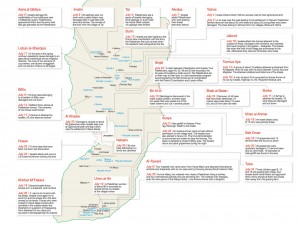
The violent confrontation – between settlers from Itamar and Giva 777, and Palestinian residents of Akraba – was the worst such incident last month. But it was, nevertheless, merely part of the daily routine of assaults, attacks and incursions. It is only on rare occasions that these incidents become news. In most cases, if there is an investigation there is no indictment.

The map presented here shows the various assaults from last month alone, but it is not complete because it does not include Jerusalem. It is based on reports that have been cross-checked, and eyewitness testimonies from the Ta’ayush Arab Jewish partnership, the United Nations Office for the Coordination of Humanitarian Affairs, and the B’Tselem: The Israeli Information Center for Human Rights in the Occupied Territories. Haaretz will continue to follow events on a regular basis and the way they are handled by the authorities.

On Saturday July 7, when the Bani Jaber brothers were working in a wheat field, their brother Jihad – who was tending the sheep – telephoned them in a panic. “Settlers have arrived at the spring and they are slaughtering the sheep,” he shouted. The two brothers were some three kilometers from the spring and orchard, east of the village of Yanun. Jawdat, 44, went to speak with the soldiers who had accompanied the Palestinian farmers to their fields.

About six months ago, the Israel Defense Forces began revisiting plans for its dormant firing range there – which contains farmers’ fields, orchards and a number of homes belonging to families from Akraba. When it was decided to use the firing range again, the IDF began forbidding the Palestinians from going to their lands there. Giva 777, an offshoot of the Itamar settlement, is in that same firing range (known as 904A ). Dror Etkes, who has been tracking the way the settlers are gaining control of lands in the West Bank, states that most of Giva 777’s tended fields are on private Palestinian lands and in the firing range.

In the past few months, Rashed Fahmi – the head of the Yanun local council; the Israeli-Palestinian group Lohamim Leshalom (Fighting for Peace ); and Rabbis for Human Rights have been waging an exhausting and prolonged campaign to get the authorities to uphold the Palestinians’ rights to work their lands. The efforts bore bitter fruit: the Palestinians were permitted to go to their fields accompanied by soldiers for one week, between July 3 and July 10. Most of the wheat had already dried up by then.

Awaiting his death

Two military jeeps joined around 40 farmers who went to their fields that Saturday. After Jihad telephoned, at around 2 P.M., Jawdat told a soldier who spoke Arabic that something bad was happening at the spring. His impression was that the soldier brushed him off contemptuously. Meanwhile, Ibrahim, 42, hurried down the hill toward the spring. He was carrying a walking stick that he uses when tending the sheep. Jihad had already fled from the scene. Some of the sheep had wandered off. The settlers were standing among the sheep that remained and, according to Ibrahim, were hitting them. There were perhaps 10 or 20 settlers. “What have the sheep done to you?” Ibrahim shouted to them in Arabic.

At this point, other family members joined him. In the meantime, three or four soldiers arrived at the scene and prevented them from approaching the sheep. The number of settlers increased. Most of them were wearing white shirts. Two of them were, apparently, armed.

Ibrahim says he waved his stick to chase a settler away from a sheep. A soldier grabbed him, he says, and hit him with the butt of his rifle, below the eye. He fell and got up, bleeding. He saw the soldier taking out plastic handcuffs to detain him. Ibrahim ran away, “out of fear they would leave me to the settlers, who would beat me” – as had happened the previous month in Orif. There were shots, he says, as he began walking toward the south, bleeding.

The soldiers who prevented Jawdat from going to his brother handcuffed him and sat him forcibly on the ground. One soldier hit him with a baton on his ear, he says. Another soldier kicked him in the same place. As he was sitting with his hands secured behind his back, he saw some of the settlers approaching him and had the impression that one was holding an ax. At that point, he says, he shut his eyes and awaited his death.

Jawdat believes he was hit with the blunt edge of the ax and lost consciousness. Eyewitnesses say that some two hours elapsed before the soldiers would allow the residents to rescue him. He remembers waking when he was transferred from an Israeli ambulance to a Palestinian one, on his way to a hospital in Nablus.

The confrontation took place in a number of spaces. No one saw the entire picture. The Akraba residents who were being attacked had the feeling that the number of settlers was constantly growing, and that there were many dozens of them. The two sides began throwing stones at each other. The soldiers fired into the air, and stun grenades and tear gas were employed against the villagers who wanted to help their fellow residents. A fire broke out in the fields, either through arson or because of the stun and tear-gas grenades. One of the villagers was wounded by a tear-gas canister. Another was hit in the arm by a rubber-coated bullet, which left a deep wound and required hospitalization.

Another relative, Adwan Bani Jaber, 58, was also in the fields. “At a distance of some 800 meters from the orchard, I came across soldiers and a settler,” he says. “A soldier began shooting and I asked him, ‘Why are you shooting? This is my home.’ And he shouted, ‘Go back!’ I asked him: ‘Where should I go? This is my home.’ The soldier then told me there was no problem, and that there were no injured.”

Adwan says he suddenly felt a blow to his head. It was a stone which, he says, was thrown by a settler, in the presence of the soldiers.

The IDF spokesman said that the army had no reports about the injuries to the three family members. He says that on July 7, “a confrontation developed between a number of settlers and a number of Palestinians. A large number of Palestinians continued to arrive at the scene of the confrontation and there was stone throwing from both sides. The Palestinians started some conflagrations. The security forces began acting to disperse the confrontation and used means for the dispersal of demonstrations. During the incident, one settler and two Palestinians were lightly injured. The injured were treated by army medical personnel at the scene, and they then evacuated the Palestinians to hospital for further treatment. The event was investigated by senior officers and the required lessons were learned.”

Jihad reported that 14 sheep were killed – four died that day and the remainder in the next few days. He no longer takes the sheep to drink at the spring.

The entire agricultural area was once again closed to residents of Akraba and Yanun. From afar, they can see the settlers who live in firing range 904A, tending their fields.

2012-07-31 Update: For the third time in a week Havat Ma’on settlers chased away palestinian minors, At-Tuwani, Southern Hebron hills

luglio 31, 2012 at 10:24 am

Update: For the third time in a week Havat Ma’on settlers chased away palestinian minors, At-Tuwani, Southern Hebron hills

italian follows

At-Tuwani, 2012-07-31

On July 31st at around 10:45 a.m. according to the witnesses one masked settler came out from Havat Ma’on outpost and started throw stones towards 7 minors (5,6,10,11,11,14,17 years old) while they were harvesting figs in Humra valley, nearby At-Tuwani village. The children ran away scared on the opposite side of the valley where their parents were working. The family is the owner of the land and live in Yatta. In the last week this is the third time that settlers coming from Havat Ma’on outpost attack palestinian children. On the 24th of July, at 6 pm, three Palestinian shepherds, one of whom is 15 years old, the other two are 9 and 13 years old, were attacked by 4 adult settlers coming from Havat Ma’on outpost near Tuba village. On the 28th of July at 5 pm a palestinian child was chased by settlers in Humra valley, one relative of the child told to Operation Dove members that the victim went to hospital for anxiety disturb connected to the attack.

Photos of the incident: http://snipurl.com/24i1prt


Coloni di Havat Ma’on attaccano bambini palestinesi per la terza volta in una settimana, At Tuwani, colline a sud di Hebron

At-Tuwani, 2012-07-31

Il 31luglio alle 10:45 del mattino secondo testimonianze dei presenti un colono mascherato dell’avamposto di Havat Ma’on ha iniziato a lanciare sassi verso 7 minorenni (di 5,6,10,11,11,14,17 anni) che stavano raccogliendo fichi nella valle di Humra, adiacente al villaggio di At-Tuwani. I bambini sono scappati impauriti sul versante opposto della valle, dove i loro genitori stavano lavorando. La famiglia è proprietaria della terra e vive nella città palestinese di Yatta. Nell’ultima settimana questa è la terza volta in cui coloni provenienti da Havat Ma’on attaccano bambini palestinesi nel corso delle loro attività quotidiane. Il 24 luglio, alle 6 del pomeriggio, 4 coloni di Havat Ma’on hanno attaccato 3 minori palestinesi mentre pascolavano le greggi vicino al villaggio di Tuba. Il 28 Luglio alle 5 del pomeriggio un bambino palestinese è stato attaccato dai coloni nella valle di Humra; un parente del bambino ha informato i volontari di Operazione Colomba che la vittima è stato visitato in ospedale per disturbi d’ansia connessi all’attacco.

Foto dell’incidente: http://snipurl.com/24i1prt

HAARETZ: Israel has 30 days to find solution for residents of West Bank village set for demolition

luglio 30, 2012 at 8:41 pm

Israel’s high court says state has responsibility to find alternative for the 27 families living in the West Bank village of Zanuta in the southern Hebron Hills.

By Chaim Levinson | Jul.30, 2012 | 11:51 AM | 2
Residents of Zanuta are in danger of losing their homes to Israeli policies.

Residents of Zanuta are in danger of losing their homes to Israeli policies. Photo by Jamila Biso, ACRI


Israel’s High Court ruled on Monday that the state has 30 days to provide a solution for residents of the West Bank village of Zanuta, which is scheduled for demolition because it was built on an archeological site. 

The village in the southern Hebron Hills is the home of 27 families. In 2007, the residents filed a joint petition to the High Court of Justice with the Association for Civil Rights in Israel requesting that the Civil Administration complete a detailed construction plan for them, and received an interim order from the court.

In a hearing that took place on Monday, the residents’ legal representative Nira Shalev said, “The residents have been in this place since before 1967, and it is the duty of the army to regularize construction in this location.”

A state legal representative, Yitzhak Bar, said that there is no possibility of regularizing buildings in the village, because it is built on an archeological site. Judge Hanan Meltzer said that the state has a responsibility to find an alternative solution. He said it was not as simple as demolishing, “but we don’t know where they will go.”

“The role of a military governor is to find a solution.” he said.

Judge Edna Arbel added, “It is advisable to think in advance where they will go, not afterwards.”

The state representative responded saying that it was not the responsibility of the military authority to find a solution. At the end of the hearing, the judges ordered the state to announce a solution within 30 days, and to announce whether or not they were planning to regularize building on the site.

Ma’an News Agency: Israeli forces close roads in south Hebron hills

luglio 30, 2012 at 10:54 am

HEBRON (Ma’an) — Israeli forces have closed several roads in the south Hebron hills, after Israel ordered the demolition of eight villages in the area to use the land for military training, local official said.
Israeli troops closed roads leading to Khirbet al-Majaz, Khirbet al-Tabban, Khirbet al-Fakheit, Halaweh, Mirkez, Jinba and Kharoubeh, a spokesman for Yatta municipality Abed Abu Fannar told Ma’an.

Abu Fannar said Israeli military bulldozers were closing the entrances to all the villages. He added that he was detained by Israeli soldiers while inspecting the area and warned not to return.

Israeli troops have informed residents of the villages that the region is a closed military zone, Abu Fannar said, and military vehicles are deployed throughout the area.

Israel’s High Court of Justice heard Israeli Defense Minister Ehud Barak’s plans to demolish the villages on Sunday, the Israeli daily Haaretz reported.

Residents of the south Hebron villages will be allowed to access their land for farming on weekends and Jewish holidays, and during two one-month periods each year, when the Israeli army is not training in the area, Haaretz reported.

Israel regards the 1,500 residents of the villages as squatters, although the villages predate the establishment of the state of Israel by over 100 years, Haaretz said.

Previous evacuation orders issued against the villages were frozen by Israel’s High Court of Justice.


Link:  http://www.maannews.net/eng/ViewDetails.aspx?ID=507622