Ha’aretz: EU looks to compile blacklist barring entry to ‘known violent’ Israeli settlers

novembre 26, 2012 at 7:53 am

EU committee of Middle East experts recommends move in response to a report on settler violence showing their increasing strength and impunity.

by Barak Ravid – Nov. 26, 2012

The European Union is recommending a blacklist of “known violent settlers” who will be blocked from entering EU member states, a Western diplomat told Haaretz.

The diplomat said no final decision has been made at the foreign ministers level, but that the EU’s committee of Middle East experts has recommended going ahead with the process. The issue is expected to come up for discussion at one of the upcoming EU foreign ministers meetings.

In January of this year, the consuls general of the EU countries in East Jerusalem and Ramallah wrote a report dealing with settler violence against Palestinians in the West Bank, especially the incidents the settlers refer to as “price tag” revenge attacks.

A message to Israel’s leaders: Don’t defend me – not like this

novembre 15, 2012 at 7:43 pm

As she listens to the rockets mortar bombs raining in her yard, a resident of Kibbutz Kfar Aza asks the government to rethink its operation on the Gaza Strip.

By Michal Vasser | Nov.15, 2012

A Palestinian boy near damaged house in Gaza

A Palestinian boy holding a window pane taken from a damaged house hit in an Israeli strike, in Gaza City, Thursday, Nov. 15, 2012. Photo by AP


I am sitting in my safe room in Kibbutz Kfar Aza and listening to the bombardment of the all-out war outside. I am no longer able to distinguish between “our” bombardments and “theirs.” The truth is that the kibbutz children do this better than I do, their “musical ear” having been developed since they were very young, and they are able to differentiate between an artillery shell and a missile fired from a helicopter and between a mortar bomb and a Qassam. Good for them.

Is this what “defending the home” looks like? I don’t understand – did all our leaders sleep through their history classes? Or maybe they studied the Mapai school curriculum or that of Education Minister Gideon Sa’ar (to my regret, the difference is not all that great) – and have wrongly interpreted the word “defense”? Does defending the well being of citizens mean a war of armageddon every few years? Hasn’t any politician ever heard of the expression “long-term planning?”

Ha’aretz: The calm before the storm in the West Bank

ottobre 27, 2012 at 12:16 pm

It’s kind of boring in the West Bank. The Gaza Strip has been closed to Israeli journalists for about six years now, and very little is actually happening in the West Bank. There is no way to reflect routine, week after week, no matter how discouraging it is. And the routine of life in the West Bank, we must admit, has been a bit more humane in recent years. The Israeli occupation has become more comfortable, a little.

There are no terror attacks and therefore there are no Arabs – in the Israeli mind. Indeed, there are no terror attacks and there are no assassinations; let us admit this as well. In recent years the occupation and resistance have been in another of their intermissions between bloodletting. But this will continue only until the next uprising, which will most certainly come – although not very soon, one might hazard.

Hello. I refuse to enlist.

ottobre 26, 2012 at 7:12 pm

Moriel. 23 anni. Israeliano. Crede nella nonviolenza. Obbiettore di coscienza. Ora, in prigione.

Lo abbiamo conosciuto ad Al Mufaqarah, un villaggio nel sud della Cisgionrdania, lo abbiamo visto lavorare e condividere con i suoi “nemici” palestinesi. Ora è in prigione, perché si è rifiutato di servire nell’esercito israeliano poiché occupa i Territori palestinesi. Non solo. Ha avuto il coraggio di dire che crede in un’alternativa alla guerra, ad “una cosa più estrema della violenza”, la nonviolenza. Quel giorno è arrivato all’appuntamento con l’ufficiale dell’esercito israeliano accompagnato da amici e parenti, sul volto la risata di chi è libero.

Questo il dialogo negli uffici dell’esercito a Gerusalemme.

Me: Hello. I refuse to enlist.

Clerk: Why don’t you want to go to the army?

Me: Because I am against the occupation.

Clerk: You’re against the occupation, so what are you for?

Me: I’m for nonviolence and peace.

The clerk mumbles something about peace shmeace, and then says: It’s clear to you that you’re going to jail, correct?

Me: Yes. It is.


Moriel sta raccontando la sua esperianza sul suo blog:  http://thelefternwall.com/

Articolo uscito su Haaretz su di lui:  http://snipurl.com/25ezjp2

Ha’aretz: A zoning intifada

agosto 13, 2012 at 5:16 pm

As European diplomats and Israeli courts deliberate the future of Palestinians in Area C, the Palestinian Authority is taking action it hopes will secure that future.

By Amira Hass | Aug.13, 2012 | 2:26 AM | 1
PA Prime Minister Salam Fayyad in the threatened village of Mufaqara.

PA Prime Minister Salam Fayyad in the threatened village of Mufaqara. The EU is referring more and more to the ‘forced transfer’ of Palestinians from Area C. Photo by Amira Hass

“How can you watch this and keep on using diplomatic language?” I asked, not expecting an answer from the three European Union diplomats in whose car I rode through the southern Hebron hills last Wednesday. By “this” I meant the sickening disparity between the lush green vegetation and the abundance of new homes in the Jewish settlements and the avalanche of demolition orders issued against tents and jury-rigged shanties where Palestinians live on their own land and 30 liters of water per person (because of Israel’s refusal to connect them to the water grid ).

This question broke the silence in the car as we left the cave village of Jinba, two or three times as old as the State of Israel, currently facing a demolition threat. To my surprise, one of the three answered: “It’s very hard.”

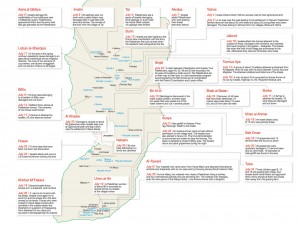
HA’ARETZ: There were more than 50 reports of Israelis assaulting Palestinians in the West Bank last month. In the start of a regular series, Haaretz details one particularly violent attack

agosto 6, 2012 at 2:37 pm

Amira Hass

There is still a bruise under Ibrahim Bani Jaber’s left eye. The blows his brother Jawdat received to his right ear didn’t leave any marks, but they still make his head feel heavy. During our meeting at their home in the West Bank village of Akraba last week, they did not spend much time describing the fear and pain they felt when they were attacked. Instead, they spoke about the family’s sheep, that they had rushed to try and save that day, July 7, when they heard that settlers were attacking them.

The violent confrontation – between settlers from Itamar and Giva 777, and Palestinian residents of Akraba – was the worst such incident last month. But it was, nevertheless, merely part of the daily routine of assaults, attacks and incursions. It is only on rare occasions that these incidents become news. In most cases, if there is an investigation there is no indictment.

The map presented here shows the various assaults from last month alone, but it is not complete because it does not include Jerusalem. It is based on reports that have been cross-checked, and eyewitness testimonies from the Ta’ayush Arab Jewish partnership, the United Nations Office for the Coordination of Humanitarian Affairs, and the B’Tselem: The Israeli Information Center for Human Rights in the Occupied Territories. Haaretz will continue to follow events on a regular basis and the way they are handled by the authorities.

On Saturday July 7, when the Bani Jaber brothers were working in a wheat field, their brother Jihad – who was tending the sheep – telephoned them in a panic. “Settlers have arrived at the spring and they are slaughtering the sheep,” he shouted. The two brothers were some three kilometers from the spring and orchard, east of the village of Yanun. Jawdat, 44, went to speak with the soldiers who had accompanied the Palestinian farmers to their fields.

About six months ago, the Israel Defense Forces began revisiting plans for its dormant firing range there – which contains farmers’ fields, orchards and a number of homes belonging to families from Akraba. When it was decided to use the firing range again, the IDF began forbidding the Palestinians from going to their lands there. Giva 777, an offshoot of the Itamar settlement, is in that same firing range (known as 904A ). Dror Etkes, who has been tracking the way the settlers are gaining control of lands in the West Bank, states that most of Giva 777’s tended fields are on private Palestinian lands and in the firing range.

In the past few months, Rashed Fahmi – the head of the Yanun local council; the Israeli-Palestinian group Lohamim Leshalom (Fighting for Peace ); and Rabbis for Human Rights have been waging an exhausting and prolonged campaign to get the authorities to uphold the Palestinians’ rights to work their lands. The efforts bore bitter fruit: the Palestinians were permitted to go to their fields accompanied by soldiers for one week, between July 3 and July 10. Most of the wheat had already dried up by then.

Awaiting his death

Two military jeeps joined around 40 farmers who went to their fields that Saturday. After Jihad telephoned, at around 2 P.M., Jawdat told a soldier who spoke Arabic that something bad was happening at the spring. His impression was that the soldier brushed him off contemptuously. Meanwhile, Ibrahim, 42, hurried down the hill toward the spring. He was carrying a walking stick that he uses when tending the sheep. Jihad had already fled from the scene. Some of the sheep had wandered off. The settlers were standing among the sheep that remained and, according to Ibrahim, were hitting them. There were perhaps 10 or 20 settlers. “What have the sheep done to you?” Ibrahim shouted to them in Arabic.

At this point, other family members joined him. In the meantime, three or four soldiers arrived at the scene and prevented them from approaching the sheep. The number of settlers increased. Most of them were wearing white shirts. Two of them were, apparently, armed.

Ibrahim says he waved his stick to chase a settler away from a sheep. A soldier grabbed him, he says, and hit him with the butt of his rifle, below the eye. He fell and got up, bleeding. He saw the soldier taking out plastic handcuffs to detain him. Ibrahim ran away, “out of fear they would leave me to the settlers, who would beat me” – as had happened the previous month in Orif. There were shots, he says, as he began walking toward the south, bleeding.

The soldiers who prevented Jawdat from going to his brother handcuffed him and sat him forcibly on the ground. One soldier hit him with a baton on his ear, he says. Another soldier kicked him in the same place. As he was sitting with his hands secured behind his back, he saw some of the settlers approaching him and had the impression that one was holding an ax. At that point, he says, he shut his eyes and awaited his death.

Jawdat believes he was hit with the blunt edge of the ax and lost consciousness. Eyewitnesses say that some two hours elapsed before the soldiers would allow the residents to rescue him. He remembers waking when he was transferred from an Israeli ambulance to a Palestinian one, on his way to a hospital in Nablus.

The confrontation took place in a number of spaces. No one saw the entire picture. The Akraba residents who were being attacked had the feeling that the number of settlers was constantly growing, and that there were many dozens of them. The two sides began throwing stones at each other. The soldiers fired into the air, and stun grenades and tear gas were employed against the villagers who wanted to help their fellow residents. A fire broke out in the fields, either through arson or because of the stun and tear-gas grenades. One of the villagers was wounded by a tear-gas canister. Another was hit in the arm by a rubber-coated bullet, which left a deep wound and required hospitalization.

Another relative, Adwan Bani Jaber, 58, was also in the fields. “At a distance of some 800 meters from the orchard, I came across soldiers and a settler,” he says. “A soldier began shooting and I asked him, ‘Why are you shooting? This is my home.’ And he shouted, ‘Go back!’ I asked him: ‘Where should I go? This is my home.’ The soldier then told me there was no problem, and that there were no injured.”

Adwan says he suddenly felt a blow to his head. It was a stone which, he says, was thrown by a settler, in the presence of the soldiers.

The IDF spokesman said that the army had no reports about the injuries to the three family members. He says that on July 7, “a confrontation developed between a number of settlers and a number of Palestinians. A large number of Palestinians continued to arrive at the scene of the confrontation and there was stone throwing from both sides. The Palestinians started some conflagrations. The security forces began acting to disperse the confrontation and used means for the dispersal of demonstrations. During the incident, one settler and two Palestinians were lightly injured. The injured were treated by army medical personnel at the scene, and they then evacuated the Palestinians to hospital for further treatment. The event was investigated by senior officers and the required lessons were learned.”

Jihad reported that 14 sheep were killed – four died that day and the remainder in the next few days. He no longer takes the sheep to drink at the spring.

The entire agricultural area was once again closed to residents of Akraba and Yanun. From afar, they can see the settlers who live in firing range 904A, tending their fields.

Ha’aretz: Israel orders demolition of 8 Palestinian villages, claims need for IDF training land

luglio 23, 2012 at 2:39 pm

Ha’aretz 23 July 2012

Amira Hass


Defense Minister Ehud Barak has ordered the demolition of eight Palestinian villages in the South Hebron Hills because the territory is needed for Israel Defense Forces training exercises, the state told the High Court of Justice on Sunday.

The residents of the targeted villages will be moved to the town of Yatta and its environs; the state claims, based on information it obtained from local informers, that most of these people have permanent homes in that area.

The state will allow the residents to work their lands and graze their flocks there when the IDF is not training — on weekends and Jewish holidays – and during two other periods of one month each during the year. Barak agreed to leave four villages that are in the northernmost part of the area, even though this would reduce the dimensions of training area and prevent the use of live fire.

The villages slated for demolition are the larger villages in the region: Majaz, Tabban, Sfai, Fakheit, Halaweh, Mirkez, Jinba, and Kharuba, which have a total of 1,500 residents. The villages to be spared are Tuba, Mufaqara, Sarura and Megheir al-Abeid, which have a total of 300 residents.

Amira Hass: The law, ass or donkey?

giugno 20, 2012 at 6:04 pm

By Amira Hass, Haaretz – 18 June 2012

Three High Court justices sit down to familiarize themselves with the facts: The residents continue to build without construction permits. And the three justices issue an interim order against any such construction within the two clusters that the petition relates to. The order was issued on June 7, the day after the petition and had been discussed.

Subject of the petition: Illegal outpost

Essence of the petition: Disregard of the laws of symmetry and the failure to implement the house-demolition orders issued regarding the structures of the said outpost. The subtext is clear: You ruled against Migron and the Ulpana neighborhood; why are you silent this time?

The justices: Asher Grunis, Hanan Melcer and Daphna Barak-Erez

The buildings: Neither low-rise apartment blocks like the ones in the Ulpana neighborhood nor single-family villas similar to housing in the West Bank settlement of Ofra (the vast majority of which is constructed on private land belonging to the villages of Silwad and Ein Yabrud, and therefore also lacks a detailed construction and development plan ), not even trailers hooked up to water and electricity like the ones in Migron and Givat Assaf. Only a cluster of hovels, tents and concrete rooms slapped together in a hurry.

Guess: The residents are Palestinians (only Palestinian “illegal outposts” remain unconnected to the electricity grid, phone and water lines ).

The land: Private Palestinian land, just like in Migron, Givat Assaf and Ofra, but unlike the Jewish outposts, this “outpost” is located on land owned by its inhabitants. No forged signatures or documents, no other acts of fraud perpetuated.

Name: Susya, southern slope of Mount Hebron

Some history: The adjacent Jewish West Bank settlement of Susya was erected in 1983.

1986: A confiscation order is issued against the lands of the Palestinian village Susya. The village is decreed an archaeological site (because of remnants of an ancient Jewish settlement ). And the Palestinian residents? Instead of treating them with respect and thanking them for preserving the location over the centuries, the IDF and Civil Administration expel them from their homes (caves located among ancient stone structures ), wells and fields.

And then? Susya’s Palestinian residents, members of the Nawaj’ah family, move onto the land they’ve been farming, into caves and tents.

July 2001: Under the guise of the second intifada, the IDF and Civil Administration expel the Nawaj’ah family for a second time. Tents are crushed, caves and wells sealed and wrecked, farmland destroyed, animals killed.

A small but surprising twist: On September 26, 2001, the High Court of Justice instructs the authorities to stop destroying the buildings at the height of a public campaign by the residents and left-wing groups, and the residents’ legal battle led by attorney Shlomo Lecker.

Despite the injunction, Jewish settlers and the army prevent the residents’ access to some 3,000 dunams (about 740 acres ) of their land.

The court orders an end to the demolition and expulsion, but does not instruct the Civil Administration to allow the Palestinians to build, forcing them to build without permits, for example, a school. As of May 2012, 18 demolition orders have been issued against hovels and buildings, including a school.

Another plot twist: Via the organization Rabbis for Human Rights, Susya residents appeal the blocked access to their private land and the fact that Jewish settlers are making a grab for it.

Another surprise twist: In October 2011, the military commanding officer declares a large part of their land as “closed to Israelis,” i.e., Jewish settlers, in order to stop the encroachment and land grab.

An attempt to fix the twist, February 2012: Regavim, a nonprofit association to protect the Jewish nation’s land, and the Jewish settlement of Susya petition the High Court to accelerate the pace of the Palestinian Susya demolition orders and to stop construction. In other words: a recipe for a third expulsion.

In her response, Attorney Avital Sharon of Rabbis for Human Rights points to the petition’s lack of good faith, and why it should be rejected outright. For example, she points to unauthorized construction in Jewish Susya and to the fact that the director general of Regavim himself lives in an unauthorized outpost.

Sharon also also gives reasons for the case in question: the earliest expulsion. The Civil Administration discriminates against Palestinians by not creating construction and development plans for them. Contrary to what is stated in the petition, the Civil Administration tirelessly demolishes Palestinian structures. In the last four years alone, 1,101 such structures have been demolished. Susya and the rabbis are busy working on a construction and development plan for the village (even though this is the responsibility of the official authorities ).

The judges listen to the supposed voice of symmetry coming from the petition submitted by Regavim and the Jewish settlement of Susya and do not reject the petition outright. They even issue an interim order to stop new construction in the village of Susya.

Construction in the Jewish settlement Susya continues, as it does in its satellite outposts.

As a result of the High Court ruling, officers of the Civil Administration show up in Susya on June 12 and hand out six collective demolition orders affecting 52 buildings, including a preschool, a clinic and a solar panel system supplying electricity to the village and its steadfast residents.

Demolition time frame: within three days (Attorney Quamar Mishirqi Assad of Rabbis for Human Rights manages to get a 10-day extension to submit challenges to the demolition orders ).

The residents of Susya ask the honorable justices Grunis, Melcer and Barak-Erez: Is this how you understand the word “justice” of your titles?

Link: http://www.haaretz.com/news/features/the-law-ass-or-donkey.premium-1.437023

Rapporto Annuale Amnesty International 2012

maggio 25, 2012 at 8:09 am

Fonte: Rapporto Annuale Amnesty International 2012
Scheda: Israele e Territori Palestinesi Occupati

Le autorità israeliane hanno in genere negato le licenze edilizie ai palestinesi residenti a Gerusalemme Est e nell’Area C della Cisgiordania, dove Israele ha mantenuto la completa autorità di pianificazione e urbanizzazione, ostacolando il loro diritto a un alloggio adeguato. Le autorità israeliane hanno intensificato la demolizione di abitazioni e di altre strutture palestinesi in Cisgiordania che erano state costruite senza permesso, abbattendo nell’arco dell’anno più di 620 strutture. Quasi 1100 palestinesi sono stati sfollati a causa delle demolizioni, un aumento dell’80 per cento rispetto al 2010; più di altri 4200 sono stati colpiti dalla distruzione di 170 rifugi per animali e 46 cisterne. Particolarmente colpite sono state le vulnerabili comunità beduine e le comunità pastorizie, alcune a rischio di sfollamento permanente a causa delle gravi restrizioni di movimento, di ripetute demolizioni e della violenza da parte dei coloni.

Maan News Agency: Settler group patrols West Bank for demolition targets

maggio 14, 2012 at 9:40 am

BETHLEHEM (Ma’an) — A tiny village of Palestinian families in the southern West Bank has had an unwelcome visitor in recent months.

“He comes with small weapons and his camera, sometimes with armed forces, sometimes with settlers,” Susiya resident Nasser Nawaja says.

The armed visitor is Ovad Arad, the Judea and Samaria Director of Regavim, an Israeli non-governmental organization.

Arad’s job is to roam the West Bank photographing Palestinian buildings for the group’s legal petitions, which demand the Israeli government expedite their demolitions.

Susiya, a hamlet of 350 people, including 120 children, is now at immediate risk of forced displacement as a result of Regavim’s petition, the United Nations humanitarian affairs office says.