A POCHI PASSI SULLA SINISTRA

dicembre 8, 2012 at 10:33 am

Arriviamo sul crinale dell’ultima collina: Nail è laggiù con le sue pecore che continuano tranquille a brucare l’erba. Ci viene incontro con quel suo sguardo fermo che manterrà per tutto il tempo nonostante quel che è appena capitato, nonostante quel che sta per capitare.

I soldati si sono da poco allontanati, ma sono ancora lì…a pochi passi sulla sinistra.

A pochi passi sulla sinistra sorge l’avamposto di Avigayil. Un avamposto è un insediamento di coloni non autorizzato, dunque illegale persino per lo stato d’Israele. Nail ha ancora la videocamera in mano. Ci mostra il filmato che ha appena fatto: i soldati gli urlano addosso “devi andartene da qui tu e le tue pecore” lui da dietro la camera risponde: “questa è la mia terra, sono in regola…”

Ha’aretz: EU looks to compile blacklist barring entry to ‘known violent’ Israeli settlers

novembre 26, 2012 at 7:53 am

EU committee of Middle East experts recommends move in response to a report on settler violence showing their increasing strength and impunity.

by Barak Ravid – Nov. 26, 2012

The European Union is recommending a blacklist of “known violent settlers” who will be blocked from entering EU member states, a Western diplomat told Haaretz.

The diplomat said no final decision has been made at the foreign ministers level, but that the EU’s committee of Middle East experts has recommended going ahead with the process. The issue is expected to come up for discussion at one of the upcoming EU foreign ministers meetings.

In January of this year, the consuls general of the EU countries in East Jerusalem and Ramallah wrote a report dealing with settler violence against Palestinians in the West Bank, especially the incidents the settlers refer to as “price tag” revenge attacks.

Fai finta

ottobre 12, 2012 at 11:47 am

Fai finta di essere un colono israeliano. Uno di quelli cresciuti a pane e Torah, nel rispetto dei vecchi saggi, leggendo commentari talmudici, celebrando Sukkot e Yom Kippur vari e mangiando rigorosamente come le antiche leggi prescrivono da secoli e secoli a questa parte, secondo il rito kosher, sempre attento a non mischiare latticini con carne. Un buon ebreo ortodosso insomma o almeno tenti di esserlo. Sei partito dalla grande città, Tel Aviv o Yaffo o Haifa che sia e, seguendo una qualche guida religiosa illuminata ti sei trasferito in questo “bucodiculodimondo”, convinto di riprenderti la terra che Dio ha assegnato a te sin dal nascere dei giorni, quando tutto era ancora da scrivere, dopo che Davide vinse Goliath.
Esci dalla tua casa, che hai costruito con le tue mani insieme a tua moglie. Fuori ci sono i tuoi figli che giocano con le galline e con le capre, in cortile sotto il sole.
Dopo 2000 anni di persecuzioni vivi nella terra che Dio ti ha donato. Finalmente.

Ha’aretz: Two masked men attack 67-year-old Palestinian shepherd in South Hebron Hills

agosto 28, 2012 at 9:12 pm

Ha’aretz / 28 agosto 2012 / Amira Hass

Ismail Adara, from the village of Bir al Eid, was attacked with a razor and sticks by two men.

Two masked men attacked and wounded Ismail Adara, a 67-year-old Palestinian shepherd on Monday, in the cave village of Bir al Eid in the South Hebron hills, as he was grazing his flock near the village. He was rushed to hospital in Hebron with wounds in the neck and fingers, and with possible head fractures.

Adara was grazing his flock on Monday afternoon next to the village, a few hundred meters from the residential buildings of the unauthorized settlement outpost of Mizpeh Yair when he was attacked by two masked men. Two of his young children, a boy and a girl, were near the scene of the attack. Immediately afterwards, he managed to use his cell phone to call Kamer Mashraqi Assad, a lawyer with the organization Rabbis for Human Rights, who notified the IDF and the police.

According to Adara, they arrived on the scene some 45 minutes after the attack. Adara told the lawyer that shortly before 5.30 P.M. he was saw two Israelis whose full names he knows driving a car and dropping off two masked men from the vehicle. The two attacked him with a razor and beat him on the head with sticks.

Adara had in his possession a thick rubber hose, which he uses while herding his flock, and he claims he protected himself with the hose, and might have managed to hit one of the two men who attacked him in the face.

Adara was taken by military ambulance, and remembers that he lost consciousness for a while. Near the Sussiya settlement, he was transferred to a Red Crescent ambulance. As far as is Mashraqi Assad knows, police asked Adara’s two young children about him, but have still not been in direct contact with the shepherd himself.

Due to repeated harassments by Israelis who live in the area, residents of Bir al Eid gradually left the village in the early 2000s, with the last resident leaving in 2003. Traffic restrictions imposed by the army and building prohibitions imposed by the Civil Administration made life there even more difficult. Residents complained to police of harassment which included the killing of their sheep, the burning of fields and crops, damage to their property, blocking access to the village, setting dogs on them, and dumping sheep carcasses into cisterns.

In a visit to the abandoned village in autumn 2007, Haaretz photographer Alex Levac, a Haaretz reporters and UN staff were attacked by two Israelis from the outpost. After a legal battle led by Rabbis for Human Rights, the residents returned to the village in 2009. Adara, who is married to four women, was one of the residents who was most anxious to return to his home, despite fears of recurring attacks. In the past three years, the residents have again complained of harassment, such as repeated damage to pipes that carry water from the well, sheep stealing, property damage and trespassing.

Fonte: Ha’aretz

Video: Havat Maon.. a promo.

agosto 21, 2012 at 1:27 pm

Havat Maon Settlement – Promo from Yoray Liberman on Vimeo.

P/R:Thirty olive trees cut nearby the Palestinian village of At-Tuwani, South Hebron Hills

agosto 19, 2012 at 3:30 pm

The olive grove belongs to a Palestinian family and it is located in front of Havat Ma’on illegal outpost

(Italian follows)

August 16th, 2012

At-Tuwani – South Hebron Hills

In the afternoon of August 16th some Palestinians discovered that an olive grove situated in Humra valley had been recently destroyed during the night, according to a Palestinian. Thirty olive trees were broken or severely damaged.

HA’ARETZ: There were more than 50 reports of Israelis assaulting Palestinians in the West Bank last month. In the start of a regular series, Haaretz details one particularly violent attack

agosto 6, 2012 at 2:37 pm

Amira Hass

There is still a bruise under Ibrahim Bani Jaber’s left eye. The blows his brother Jawdat received to his right ear didn’t leave any marks, but they still make his head feel heavy. During our meeting at their home in the West Bank village of Akraba last week, they did not spend much time describing the fear and pain they felt when they were attacked. Instead, they spoke about the family’s sheep, that they had rushed to try and save that day, July 7, when they heard that settlers were attacking them.

The violent confrontation – between settlers from Itamar and Giva 777, and Palestinian residents of Akraba – was the worst such incident last month. But it was, nevertheless, merely part of the daily routine of assaults, attacks and incursions. It is only on rare occasions that these incidents become news. In most cases, if there is an investigation there is no indictment.

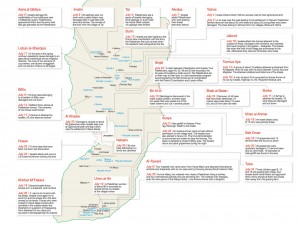
The map presented here shows the various assaults from last month alone, but it is not complete because it does not include Jerusalem. It is based on reports that have been cross-checked, and eyewitness testimonies from the Ta’ayush Arab Jewish partnership, the United Nations Office for the Coordination of Humanitarian Affairs, and the B’Tselem: The Israeli Information Center for Human Rights in the Occupied Territories. Haaretz will continue to follow events on a regular basis and the way they are handled by the authorities.

On Saturday July 7, when the Bani Jaber brothers were working in a wheat field, their brother Jihad – who was tending the sheep – telephoned them in a panic. “Settlers have arrived at the spring and they are slaughtering the sheep,” he shouted. The two brothers were some three kilometers from the spring and orchard, east of the village of Yanun. Jawdat, 44, went to speak with the soldiers who had accompanied the Palestinian farmers to their fields.

About six months ago, the Israel Defense Forces began revisiting plans for its dormant firing range there – which contains farmers’ fields, orchards and a number of homes belonging to families from Akraba. When it was decided to use the firing range again, the IDF began forbidding the Palestinians from going to their lands there. Giva 777, an offshoot of the Itamar settlement, is in that same firing range (known as 904A ). Dror Etkes, who has been tracking the way the settlers are gaining control of lands in the West Bank, states that most of Giva 777’s tended fields are on private Palestinian lands and in the firing range.

In the past few months, Rashed Fahmi – the head of the Yanun local council; the Israeli-Palestinian group Lohamim Leshalom (Fighting for Peace ); and Rabbis for Human Rights have been waging an exhausting and prolonged campaign to get the authorities to uphold the Palestinians’ rights to work their lands. The efforts bore bitter fruit: the Palestinians were permitted to go to their fields accompanied by soldiers for one week, between July 3 and July 10. Most of the wheat had already dried up by then.

Awaiting his death

Two military jeeps joined around 40 farmers who went to their fields that Saturday. After Jihad telephoned, at around 2 P.M., Jawdat told a soldier who spoke Arabic that something bad was happening at the spring. His impression was that the soldier brushed him off contemptuously. Meanwhile, Ibrahim, 42, hurried down the hill toward the spring. He was carrying a walking stick that he uses when tending the sheep. Jihad had already fled from the scene. Some of the sheep had wandered off. The settlers were standing among the sheep that remained and, according to Ibrahim, were hitting them. There were perhaps 10 or 20 settlers. “What have the sheep done to you?” Ibrahim shouted to them in Arabic.

At this point, other family members joined him. In the meantime, three or four soldiers arrived at the scene and prevented them from approaching the sheep. The number of settlers increased. Most of them were wearing white shirts. Two of them were, apparently, armed.

Ibrahim says he waved his stick to chase a settler away from a sheep. A soldier grabbed him, he says, and hit him with the butt of his rifle, below the eye. He fell and got up, bleeding. He saw the soldier taking out plastic handcuffs to detain him. Ibrahim ran away, “out of fear they would leave me to the settlers, who would beat me” – as had happened the previous month in Orif. There were shots, he says, as he began walking toward the south, bleeding.

The soldiers who prevented Jawdat from going to his brother handcuffed him and sat him forcibly on the ground. One soldier hit him with a baton on his ear, he says. Another soldier kicked him in the same place. As he was sitting with his hands secured behind his back, he saw some of the settlers approaching him and had the impression that one was holding an ax. At that point, he says, he shut his eyes and awaited his death.

Jawdat believes he was hit with the blunt edge of the ax and lost consciousness. Eyewitnesses say that some two hours elapsed before the soldiers would allow the residents to rescue him. He remembers waking when he was transferred from an Israeli ambulance to a Palestinian one, on his way to a hospital in Nablus.

The confrontation took place in a number of spaces. No one saw the entire picture. The Akraba residents who were being attacked had the feeling that the number of settlers was constantly growing, and that there were many dozens of them. The two sides began throwing stones at each other. The soldiers fired into the air, and stun grenades and tear gas were employed against the villagers who wanted to help their fellow residents. A fire broke out in the fields, either through arson or because of the stun and tear-gas grenades. One of the villagers was wounded by a tear-gas canister. Another was hit in the arm by a rubber-coated bullet, which left a deep wound and required hospitalization.

Another relative, Adwan Bani Jaber, 58, was also in the fields. “At a distance of some 800 meters from the orchard, I came across soldiers and a settler,” he says. “A soldier began shooting and I asked him, ‘Why are you shooting? This is my home.’ And he shouted, ‘Go back!’ I asked him: ‘Where should I go? This is my home.’ The soldier then told me there was no problem, and that there were no injured.”

Adwan says he suddenly felt a blow to his head. It was a stone which, he says, was thrown by a settler, in the presence of the soldiers.

The IDF spokesman said that the army had no reports about the injuries to the three family members. He says that on July 7, “a confrontation developed between a number of settlers and a number of Palestinians. A large number of Palestinians continued to arrive at the scene of the confrontation and there was stone throwing from both sides. The Palestinians started some conflagrations. The security forces began acting to disperse the confrontation and used means for the dispersal of demonstrations. During the incident, one settler and two Palestinians were lightly injured. The injured were treated by army medical personnel at the scene, and they then evacuated the Palestinians to hospital for further treatment. The event was investigated by senior officers and the required lessons were learned.”

Jihad reported that 14 sheep were killed – four died that day and the remainder in the next few days. He no longer takes the sheep to drink at the spring.

The entire agricultural area was once again closed to residents of Akraba and Yanun. From afar, they can see the settlers who live in firing range 904A, tending their fields.

2012-07-31 Update: For the third time in a week Havat Ma’on settlers chased away palestinian minors, At-Tuwani, Southern Hebron hills

luglio 31, 2012 at 10:24 am

Update: For the third time in a week Havat Ma’on settlers chased away palestinian minors, At-Tuwani, Southern Hebron hills

italian follows

At-Tuwani, 2012-07-31

On July 31st at around 10:45 a.m. according to the witnesses one masked settler came out from Havat Ma’on outpost and started throw stones towards 7 minors (5,6,10,11,11,14,17 years old) while they were harvesting figs in Humra valley, nearby At-Tuwani village. The children ran away scared on the opposite side of the valley where their parents were working. The family is the owner of the land and live in Yatta. In the last week this is the third time that settlers coming from Havat Ma’on outpost attack palestinian children. On the 24th of July, at 6 pm, three Palestinian shepherds, one of whom is 15 years old, the other two are 9 and 13 years old, were attacked by 4 adult settlers coming from Havat Ma’on outpost near Tuba village. On the 28th of July at 5 pm a palestinian child was chased by settlers in Humra valley, one relative of the child told to Operation Dove members that the victim went to hospital for anxiety disturb connected to the attack.

Photos of the incident: http://snipurl.com/24i1prt


Coloni di Havat Ma’on attaccano bambini palestinesi per la terza volta in una settimana, At Tuwani, colline a sud di Hebron

At-Tuwani, 2012-07-31

Il 31luglio alle 10:45 del mattino secondo testimonianze dei presenti un colono mascherato dell’avamposto di Havat Ma’on ha iniziato a lanciare sassi verso 7 minorenni (di 5,6,10,11,11,14,17 anni) che stavano raccogliendo fichi nella valle di Humra, adiacente al villaggio di At-Tuwani. I bambini sono scappati impauriti sul versante opposto della valle, dove i loro genitori stavano lavorando. La famiglia è proprietaria della terra e vive nella città palestinese di Yatta. Nell’ultima settimana questa è la terza volta in cui coloni provenienti da Havat Ma’on attaccano bambini palestinesi nel corso delle loro attività quotidiane. Il 24 luglio, alle 6 del pomeriggio, 4 coloni di Havat Ma’on hanno attaccato 3 minori palestinesi mentre pascolavano le greggi vicino al villaggio di Tuba. Il 28 Luglio alle 5 del pomeriggio un bambino palestinese è stato attaccato dai coloni nella valle di Humra; un parente del bambino ha informato i volontari di Operazione Colomba che la vittima è stato visitato in ospedale per disturbi d’ansia connessi all’attacco.

Foto dell’incidente: http://snipurl.com/24i1prt

2012-07-28 Update: Havat Ma’on masked settlers traumatized palestinian child in Humra valley, near At-Tuwani village, Southern Hebron hills

luglio 28, 2012 at 9:36 pm

At around 4:45 pm Operation Dove volunteers were called by a palestinian shepherd from Maghayir Al Abeed village who ask to them to look at one child that was coming to Al-Karmil from Maghayir Al Abeed. When Operation Dove volunteers arrived in Humra valley they found 5 masked settlers that started to throw rocks against them, also with slingshot. One palestinian told to the internationals that the settlers chased the child before their arrival. After, the settlers attacked the volunteers and stopped just when some palestinians came from At-Tuwani. The settlers returned inside Havat Ma’on woods. One relative of the chased child told to Operation Dove members that the victim went to hospital for anxiety disturb connected to the attack.

Pictures of the incident:  http://snipurl.com/24h2fa4

2012-07-24 Settlers from Havat Ma’on attacked three palestinian minors nearby the palestinian village of Tuba, South Hebron Hills

luglio 27, 2012 at 2:43 pm

Settlers from Havat Ma’on attacked three palestinian minors nearby the palestinian village of Tuba, South Hebron Hills

(Italian follows)

July 26th, 2012

At-Tuwani- South Hebron Hills

On the 24th of July, at 6 pm, three Palestinian shepherds, one of whom is 15 years old, the other two are 9 and 13 years old, were attacked by 4 adult settlers coming from Havat Ma’on outpost.

According to the witnesses, the shepherds were grazing close to the Palestinian village of Tuba, when the 4 settlers approched them threateningly, throwing stones and running after them, forcing them to leave.