 Amira Hass
There is still a bruise under Ibrahim Bani Jaber’s left eye. The blows his brother Jawdat received to his right ear didn’t leave any marks, but they still make his head feel heavy. During our meeting at their home in the West Bank village of Akraba last week, they did not spend much time describing the fear and pain they felt when they were attacked. Instead, they spoke about the family’s sheep, that they had rushed to try and save that day, July 7, when they heard that settlers were attacking them.
The violent confrontation – between settlers from Itamar and Giva 777, and Palestinian residents of Akraba – was the worst such incident last month. But it was, nevertheless, merely part of the daily routine of assaults, attacks and incursions. It is only on rare occasions that these incidents become news. In most cases, if there is an investigation there is no indictment.
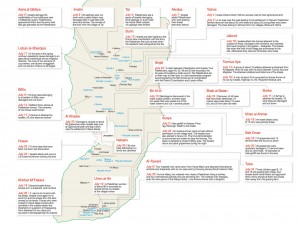
The map presented here shows the various assaults from last month alone, but it is not complete because it does not include Jerusalem. It is based on reports that have been cross-checked, and eyewitness testimonies from the Ta’ayush Arab Jewish partnership, the United Nations Office for the Coordination of Humanitarian Affairs, and the B’Tselem: The Israeli Information Center for Human Rights in the Occupied Territories. Haaretz will continue to follow events on a regular basis and the way they are handled by the authorities.
On Saturday July 7, when the Bani Jaber brothers were working in a wheat field, their brother Jihad – who was tending the sheep – telephoned them in a panic. “Settlers have arrived at the spring and they are slaughtering the sheep,” he shouted. The two brothers were some three kilometers from the spring and orchard, east of the village of Yanun. Jawdat, 44, went to speak with the soldiers who had accompanied the Palestinian farmers to their fields.
About six months ago, the Israel Defense Forces began revisiting plans for its dormant firing range there – which contains farmers’ fields, orchards and a number of homes belonging to families from Akraba. When it was decided to use the firing range again, the IDF began forbidding the Palestinians from going to their lands there. Giva 777, an offshoot of the Itamar settlement, is in that same firing range (known as 904A ). Dror Etkes, who has been tracking the way the settlers are gaining control of lands in the West Bank, states that most of Giva 777’s tended fields are on private Palestinian lands and in the firing range.
In the past few months, Rashed Fahmi – the head of the Yanun local council; the Israeli-Palestinian group Lohamim Leshalom (Fighting for Peace ); and Rabbis for Human Rights have been waging an exhausting and prolonged campaign to get the authorities to uphold the Palestinians’ rights to work their lands. The efforts bore bitter fruit: the Palestinians were permitted to go to their fields accompanied by soldiers for one week, between July 3 and July 10. Most of the wheat had already dried up by then.
Awaiting his death
Two military jeeps joined around 40 farmers who went to their fields that Saturday. After Jihad telephoned, at around 2 P.M., Jawdat told a soldier who spoke Arabic that something bad was happening at the spring. His impression was that the soldier brushed him off contemptuously. Meanwhile, Ibrahim, 42, hurried down the hill toward the spring. He was carrying a walking stick that he uses when tending the sheep. Jihad had already fled from the scene. Some of the sheep had wandered off. The settlers were standing among the sheep that remained and, according to Ibrahim, were hitting them. There were perhaps 10 or 20 settlers. “What have the sheep done to you?” Ibrahim shouted to them in Arabic.
At this point, other family members joined him. In the meantime, three or four soldiers arrived at the scene and prevented them from approaching the sheep. The number of settlers increased. Most of them were wearing white shirts. Two of them were, apparently, armed.
Ibrahim says he waved his stick to chase a settler away from a sheep. A soldier grabbed him, he says, and hit him with the butt of his rifle, below the eye. He fell and got up, bleeding. He saw the soldier taking out plastic handcuffs to detain him. Ibrahim ran away, “out of fear they would leave me to the settlers, who would beat me” – as had happened the previous month in Orif. There were shots, he says, as he began walking toward the south, bleeding.
The soldiers who prevented Jawdat from going to his brother handcuffed him and sat him forcibly on the ground. One soldier hit him with a baton on his ear, he says. Another soldier kicked him in the same place. As he was sitting with his hands secured behind his back, he saw some of the settlers approaching him and had the impression that one was holding an ax. At that point, he says, he shut his eyes and awaited his death.
Jawdat believes he was hit with the blunt edge of the ax and lost consciousness. Eyewitnesses say that some two hours elapsed before the soldiers would allow the residents to rescue him. He remembers waking when he was transferred from an Israeli ambulance to a Palestinian one, on his way to a hospital in Nablus.
The confrontation took place in a number of spaces. No one saw the entire picture. The Akraba residents who were being attacked had the feeling that the number of settlers was constantly growing, and that there were many dozens of them. The two sides began throwing stones at each other. The soldiers fired into the air, and stun grenades and tear gas were employed against the villagers who wanted to help their fellow residents. A fire broke out in the fields, either through arson or because of the stun and tear-gas grenades. One of the villagers was wounded by a tear-gas canister. Another was hit in the arm by a rubber-coated bullet, which left a deep wound and required hospitalization.
Another relative, Adwan Bani Jaber, 58, was also in the fields. “At a distance of some 800 meters from the orchard, I came across soldiers and a settler,” he says. “A soldier began shooting and I asked him, ‘Why are you shooting? This is my home.’ And he shouted, ‘Go back!’ I asked him: ‘Where should I go? This is my home.’ The soldier then told me there was no problem, and that there were no injured.”
Adwan says he suddenly felt a blow to his head. It was a stone which, he says, was thrown by a settler, in the presence of the soldiers.
The IDF spokesman said that the army had no reports about the injuries to the three family members. He says that on July 7, “a confrontation developed between a number of settlers and a number of Palestinians. A large number of Palestinians continued to arrive at the scene of the confrontation and there was stone throwing from both sides. The Palestinians started some conflagrations. The security forces began acting to disperse the confrontation and used means for the dispersal of demonstrations. During the incident, one settler and two Palestinians were lightly injured. The injured were treated by army medical personnel at the scene, and they then evacuated the Palestinians to hospital for further treatment. The event was investigated by senior officers and the required lessons were learned.”
Jihad reported that 14 sheep were killed – four died that day and the remainder in the next few days. He no longer takes the sheep to drink at the spring.
The entire agricultural area was once again closed to residents of Akraba and Yanun. From afar, they can see the settlers who live in firing range 904A, tending their fields.